#Monument
Kilpelänkangas Memorial
Kilpelänkangas combines history and nature: a memorial honours the fallen soldiers, while a 3.5km trail leads visitors through landscapes marked by the Winter War.
Kilpelänkangas was the scene of the fiercest Winter War battles in Kuhmo. The Winter War was a war between the Soviet Union and Finland. It began with the Soviet invasion of Finland on 30 November 1939, three months after the outbreak of World War II, and ended three and a half months later with the Moscow Peace Treaty on 13 March 1940.
Fighting in Kilpelänkangas began on the first day of the Winter War when Soviet forces first attacked. After several attempts, the Finns seized the area on 9 February 1940 during a major counteroffensive. A defensive line was quickly established, and Detachment Hyvärinen repelled repeated Soviet attacks despite heavy artillery fire. However, on 3 March, after intense bombardment and mounting pressure, the Soviet forces broke through, forcing Finnish troops to retreat to Löytövaara.
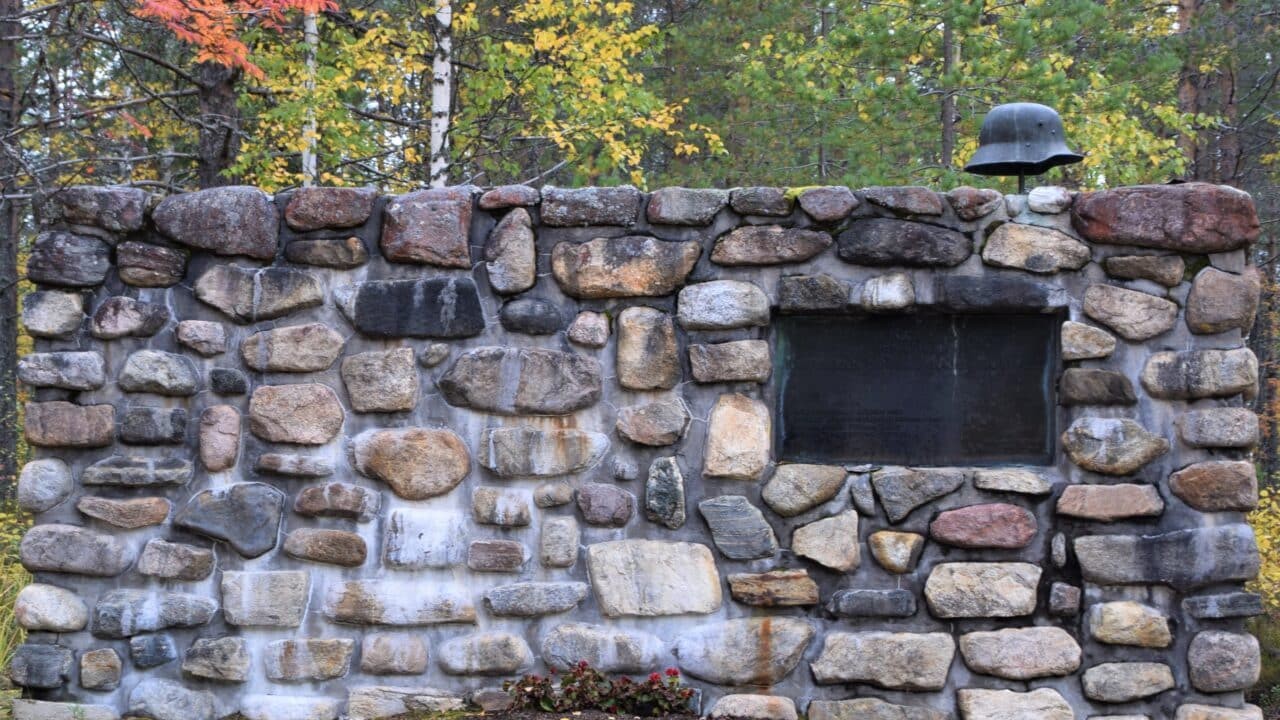
The memorial at Kilpelänkangas, unveiled on 10 August 1958, was designed by architect Birger Stenbäck, who fought in the battle. The inscription on the memorial states:
“In memory of those who fell during the Winter War in Kuhmo 1939–1940. Here Finnish men defended steadfastly their fatherland. May their actions be an obligation to future generations.”
A helmet atop the monument symbolises the fate of hundreds who fought in these forests. Today, the site stands as a solemn tribute to their sacrifice.
Visitors can explore the 3.5 km Kilpelänkangas hiking trail, which winds through terrain still marked by war: shrapnel-scarred trees, remnants of trenches, and bomb craters. The route also reveals traces of post-war logging along Kuusijoki, offering a unique blend of natural beauty and historical depth. Information boards and lean-to shelters make the trail accessible for those wishing to experience both history and nature in one journey.