#Landmark
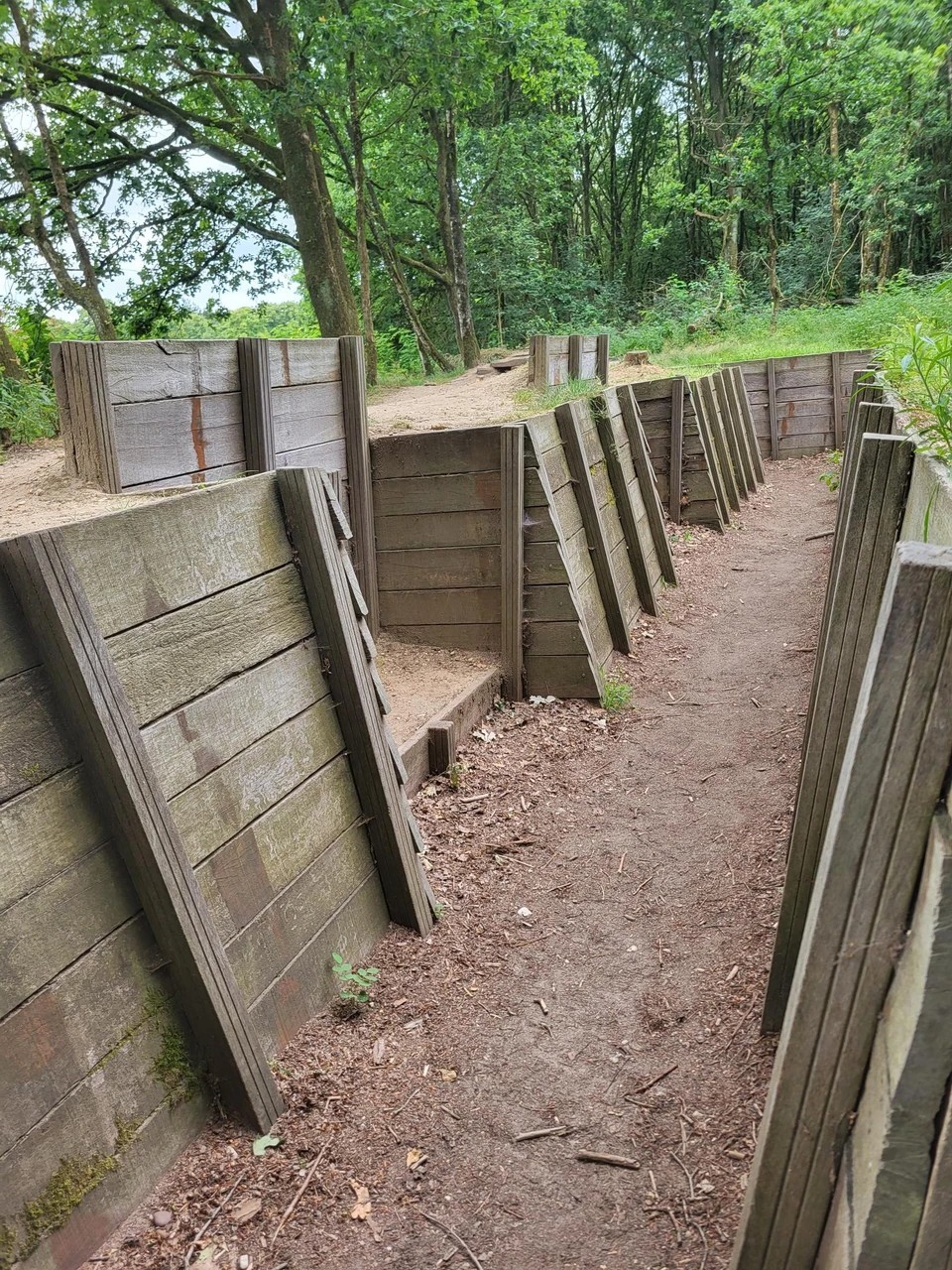
In the trench
This reconstructed trench was part of the stop line on the Grebbeberg and serves as an example of the defensive works used by Dutch soldiers here in May 1940. The Grebbeberg was a crucial component of the Grebbe Line, a defensive line designed to protect the Netherlands from an enemy attack coming from the east. The defense of the Grebbeberg was organized along three lines: the outposts, the front line, and the stop line.
Due to the foreground in front of the Grebbeberg being too high to flood, outposts were established there—a limited number of soldiers positioned in the flat land between Wageningen and the Grebbeberg, about 1.5 to 2 kilometers ahead of the front line. The outposts, consisting of over 500 soldiers, were intended to absorb the initial impact of the German attack. However, they were quickly overrun when the enemy arrived.
The front line was designed to conduct a stubborn defense to halt the enemy advance definitively. It was formed by the Hoornwerk, an ancient defensive structure at the foot of the Grebbeberg, the Grift River, and the eastern edge of the Grebbeberg.
The stop line, which ran across the mountain west of the cemetery and had a relatively weak occupation, would only be activated if small groups of German soldiers broke through the front line. The task of the soldiers in the stop line was to drive the German enemy back off the Berg.
The Absence of Connecting Trenches
A weak point in the defense setup on the Grebbeberg was the lack of connecting trenches between the stop line and the front line. As a result, the supply of reserve troops, ammunition, and food had to take place above ground, exposing them to significant danger. The same applied to the evacuation of the wounded.
Additionally, connecting trenches would have played a crucial role in communication, relaying orders and information—a role that became even more important when telephone lines were completely destroyed by the continuous artillery bombardments.
A critical task for the connecting trenches would have been in the event of an enemy breakthrough of the front line. By connecting the stop line to the front line with a connecting trench every 200 meters, a block pattern would have been created: each block consisting of a section of the stop line, a section of the front line, and two connecting trenches.
If the enemy broke through the front line anywhere, they could have been contained within one or two blocks. The advantage would have been that Dutch soldiers could have engaged the enemy not only from the stop line but also from the connecting trenches. The enemy, attacked from three sides, would have faced extreme difficulty and might have been forced to retreat.
However, this never happened. The absence of connecting trenches deprived the Dutch army of the ability to contain the German enemy after a breakthrough in the front line and gave the German troops the opportunity to spread freely across the Berg after such a breakthrough.
On 12 May, Major Jacometti launched the first counterattack from the stop line with about 35 men and two malfunctioning machine guns to drive the enemy off the Berg. The group stood no chance against the overwhelming German forces. During this counterattack, the major was killed, along with a significant number of the soldiers he led. In the afternoon of 13 May, the stop line collapsed under the pressure of the enemy attack, marking the definitive loss of the Battle of the Grebbeberg for the Netherlands.
Heimersteinselaan, 3911 AZ Rhenen
info@grebbeberg.nl