#Story
Bleeding trees
These three beech trees stand between the Heimersteinse Laan and the forest path that curves to the northwest. The visibly scarred trees are silent witnesses to the fierce battle that raged here during the Battle of the Grebbeberg.
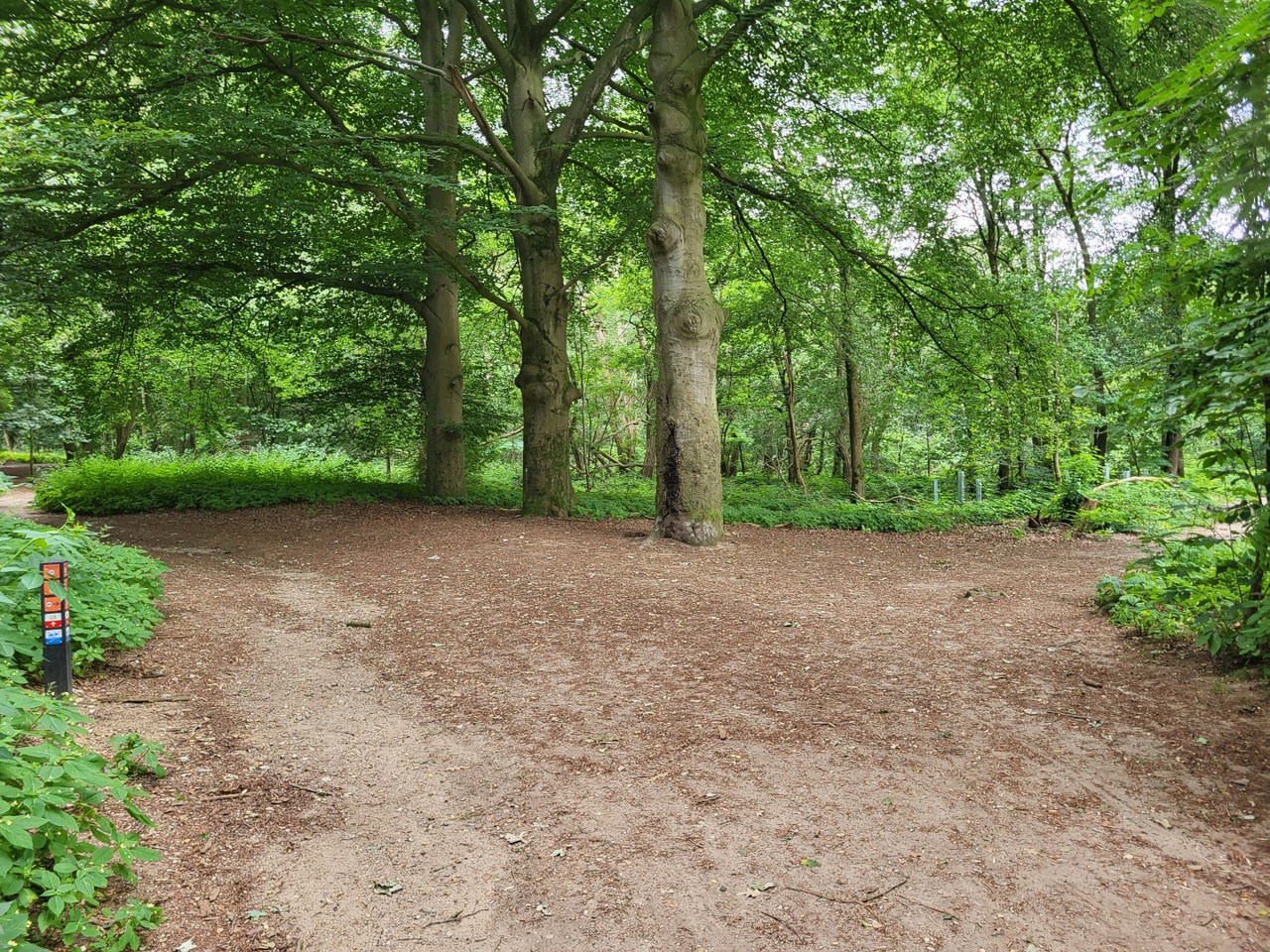
The Advisory Office for Archaeology and Cultural History (in Dutch: RAAP) used a metal detector to examine these trees and found that iron and copper fragments had deeply penetrated the wood up to human height. These remnants can be traced back to the intense German rifle and artillery fire directed at this sector. Even now, it seems as though the trees are bleeding from the holes that were struck into their bark at the time.
Just north of the beech trees, you can see a shallow pit. During the May Days of 1940, an old cannon, known as the "6-veld", was positioned there. From a casemate made of wood and earth, this cannon could fire across the forward stop line to cover the Heimersteinse Laan. Approximately 200 6-veld cannons were introduced into the Dutch army starting in 1894. In 1939–1940, due to a lack of better options, they were added to the defense as anti-tank guns, a role for which they were actually unsuitable.
For the men operating the 6-veld cannon here, the war ended disastrously. The section commander, Cornet Mignot, was shot dead by the Germans during the retreat in the afternoon of May 13, as were the gunners Hengeveld and Hoefsmid. The third gunner, Van Grinsven, was shot in the leg, and only the piece commander, Van Rhijn, emerged from the battle unscathed.) used a metal detector to examine these trees and found that iron and copper fragments had deeply penetrated the wood up to human height. These remnants can be traced back to the intense German rifle and artillery fire directed at this sector. Even now, it seems as though the trees are bleeding from the holes that were struck into their bark at the time.
Just north of the beech trees, you can see a shallow pit. During the May Days of 1940, an old cannon, known as the "6-veld", was positioned there. From a casemate made of wood and earth, this cannon could fire across the forward stop line to cover the Heimersteinse Laan. Approximately 200 6-veld cannons were introduced into the Dutch army starting in 1894. In 1939–1940, due to a lack of better options, they were added to the defense as anti-tank guns, a role for which they were actually unsuitable.
For the men operating the 6-veld cannon here, the war ended disastrously. The section commander, Cornet Mignot, was shot dead by the Germans during the retreat in the afternoon of May 13, as were the gunners Hengeveld and Hoefsmid. The third gunner, Van Grinsven, was shot in the leg, and only the piece commander, Van Rhijn, emerged from the battle unscathed.
Heimersteinselaan 3911 AZ Rhenen
info@grebbeberg.nl