#Fortification
Casemate S-17, the Porcupine
Casemates are the most striking evidence of the military history of the Grebbe Line. While the Germans use the term bunker for such structures, in Dutch, they are referred to as kazemat. The origin of the word kazemat is not entirely clear, but it is likely derived from the Italian casa armata, meaning "armed house."
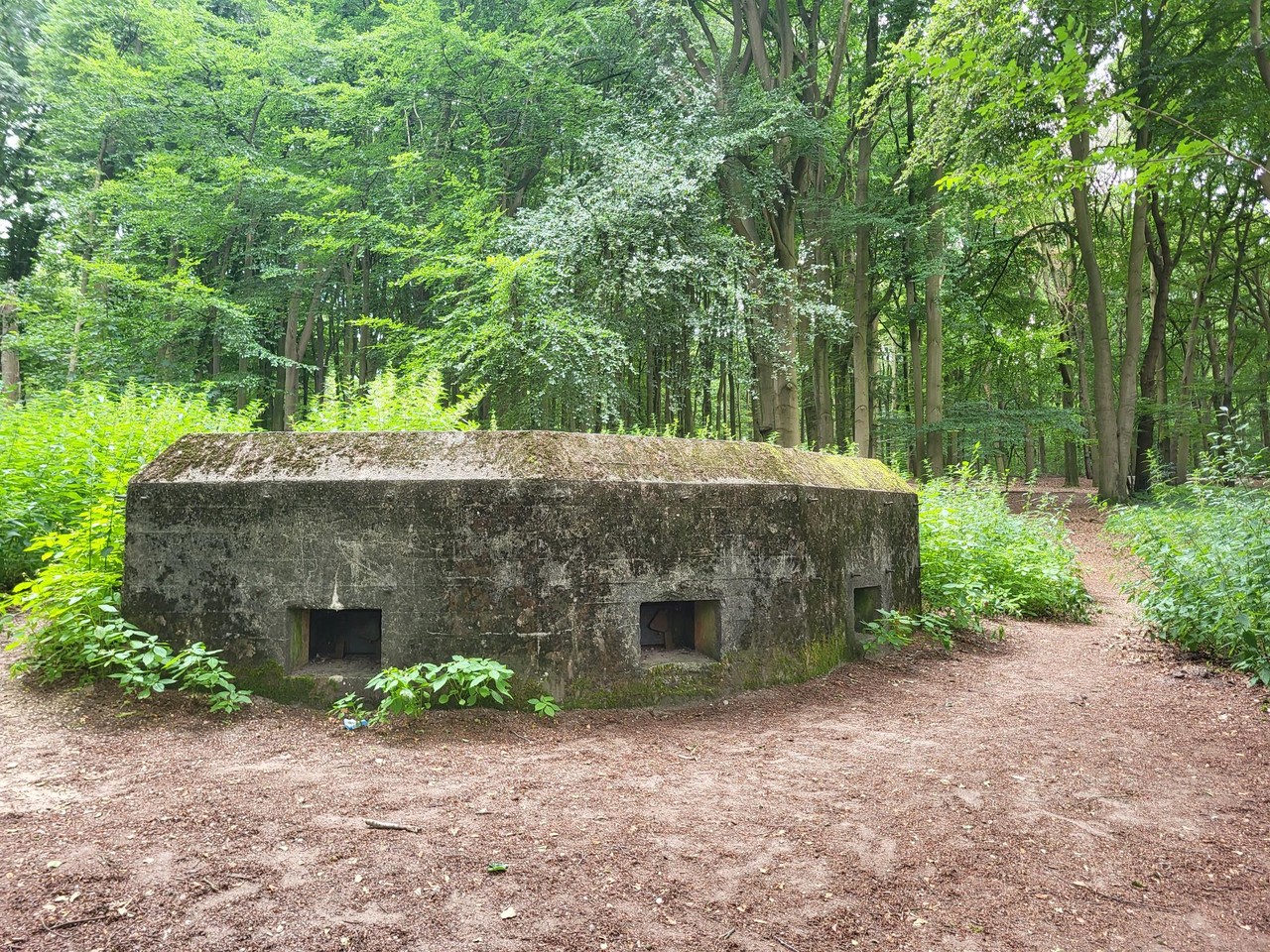
There are different types of casemates, such as S-casemates, G-casemates, B-casemates, and Pag-casemates.
In total, nearly 300 casemates were built in the Grebbe Line, with the vast majority constructed between 1939 and 1940.
The S-casemate is also known as the "porcupine," which explains its type designation "S." The comparison to a porcupine comes from the iron wire ends protruding from the concrete, intended for attaching camouflage material. All casemates on the Grebbeberg have a number and type designation—this one is S-17.
Normally, this casemate would have housed one heavy machine gun, but for unclear reasons, during the May Days of 1940, two machine guns were placed in S-17. Originally, the Grebbe Line was intended as a forward defense for the New Dutch Water Line. This explains the relatively light construction of many casemates in the Grebbe Line. Walls of 80 centimeters of concrete, like those of S-17, do not meet the minimum requirements for a casemate and are certainly not resistant to the average German shell.
When, in February 1940, the change in high command took place—General Reynders was replaced by General Winkelman—and the Grebbe Line was designated as the main defense, plans were made to build heavier casemates between the Grebbeberg and the IJsselmeer. However, these plans never progressed beyond the drawing board.
Casemate S-17 was built in November 1939. On 12 May 1940, the crew of this casemate had a clear view of a group of SS soldiers who, from the vicinity of Kruiponder Farm, managed to reach the other side of the Grift. The heavy machine guns of S-17 were able to prevent further German advancement there.
Increasingly, the occupants of S-17 heard bullets striking the back of the casemate. At first, the soldiers thought it was friendly fire. But when it became clear that the enemy was approaching from the rear, the situation became hopeless. "Turning our machine guns around was not possible, and the single rifleman and carbine shooter stationed against the parapet was powerless against them."
Ultimately, surrender was inevitable, and the white flag was raised. Shortly afterward, the crew of S-17 marched with their hands raised toward their captivity.
Heimersteinselaan, 3911 RG Rhenen
info@grebbeberg.nl