#Monument
Ilajanjoki river memorial
A memorial stand at this site where a Red Army attack was blunted in July 1944 during the Continuation War, a conflict between Finland and the Soviet Union during World War II. The engagement was the only action within the present-day borders of Finland where a Panzerschreck was employed.
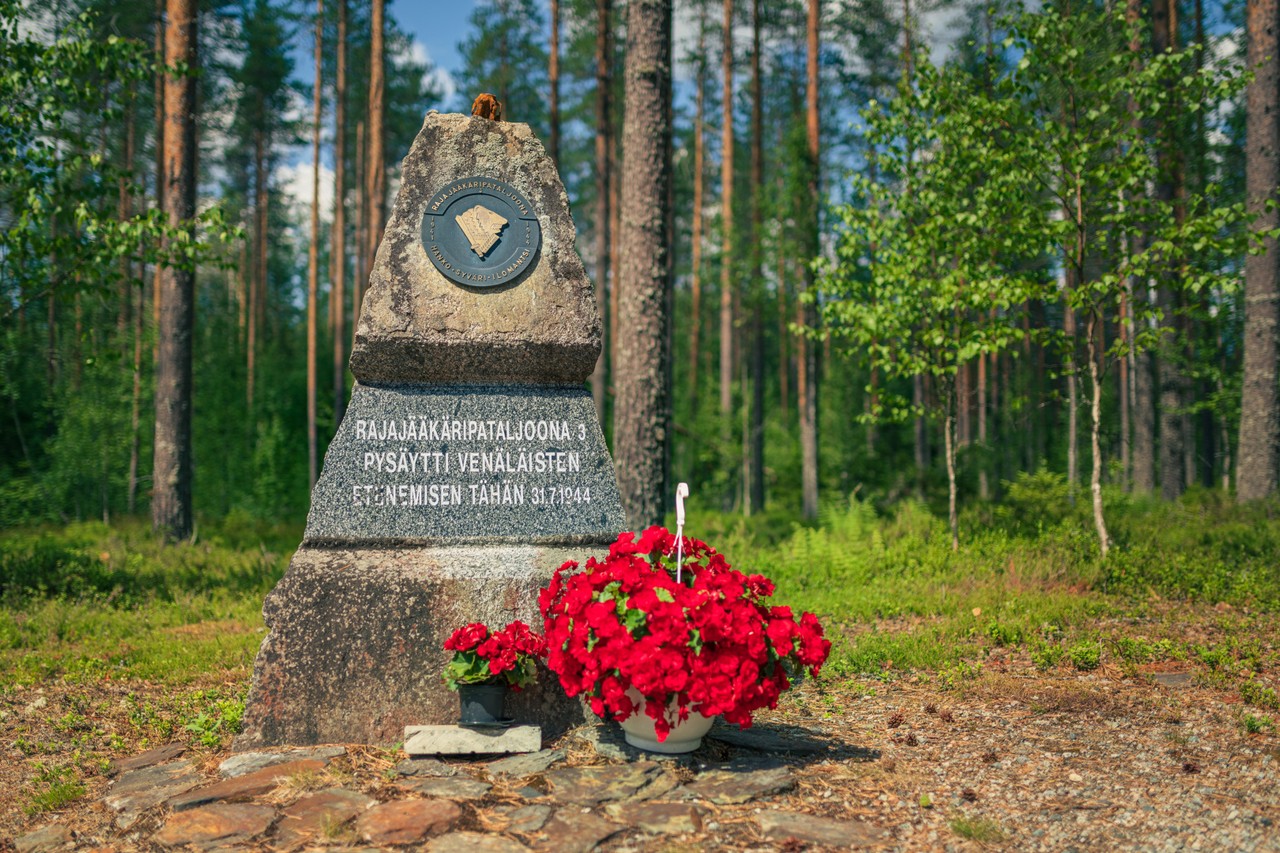
In July 1944, Finnish forces began to deploy to Ilomantsi in anticipation of a Red Army attack. A temporary formation named Group Raappana was established for the operation.
On the same day, the enemy sustained significant losses in an engagement 1.5 kilometres east of the Ilajanjoki river. The defenders were opposed by the Red Army’s 52nd Penal Unit, a collection of convicts mobilised for military service.
After receiving reinforcements during the morning of 30 July, the enemy began to advance in the general direction of the road. The situation was aggravated after the Russians set the dry forest floor on fire and sent four tanks to spearhead the attack under smoke cover. Artillery shells and mortar rounds ignited localised fires.
The defenders were forced to retreat hastily toward the Ilajanjoki river, often through fierce flames. But the wall of flame also hampered the pursuing enemy forces and negated some of the advantage they had wished to gain by starting the conflagration.
The Finnish forces were entrenched on the eastern bank of the river, where an anti-tank gun was already in position. The gun crew fired at the leading Red Army tanks without success. Events took a turn for the better when Border Jaeger (highly trained light infantry soldier to the Finnish Border Guard), Esko Kiisseli, arrived with a Panzerschreck, a reusable shoulder-fired anti-tank rocket launcher of German design. Kiisseli, who had received a crash course on the weapon, moved to a position 100 metres east of where the battle memorial is located today, and fired in quick succession three shots, all of which found their mark.
Both leading tanks were destroyed and the third was damaged. Kiisseli was then wounded. The engagement was the only action within the present-day borders of Finland where a Panzerschreck was employed, with remarkable success.
A Finnish force over three companies strong had established a defensive line east of the river bridge but was forced to withdraw to the far bank, after which soldiers blew up the bridge. Meanwhile, the enemy’s 55th Rifle Regiment began to withdraw toward Lake Niemijärvi with Finnish forces in hot pursuit. After 24 hours, the Russian unit crossed the present-day border and was soon encircled in the famous Vellivaara pocket.
Niemijärventie, Ilomantsi
+358 50 337 7379 / info@visitilomantsi.fi / https://www.facebook.com/ilomantsinsotatie