#Story
Vasilly Marempolsky at Immelmann and Brinkforth
Vasilly Marempolsky, who was from the Ukrainian village of Markushino in the Poltava region, was just 16 years old when he was taken prisoner by German Forces and brought across Europe to Jersey. Like thousands of other ‘Russians’ - including Ukrainians, Russians, Moldavians, Tartars and Belorussians – Vasilly became a slave worker for the Organisation Todt (OT, the civil and military engineering body of Nazi Germany). He was encamped at Lager Immelmann and Lager Brinkforth on the west coast of Jersey.
Jerseyman Edward Le Quesne’s description from August 1942 captures Vasilly’s own experience: ‘Some 1,100 peasants from the Ukraine arrived in the early morning. A large number were mere boys of from fourteen to sixteen years of age. Others were men of seventy and over and hardly any were men who looked anything like soldiers. Few had boots or shoes, some had no coats, and some had only a lady’s blouse and a pair of trousers. All looked half-starved and were in the charge of fat bellied OT men armed with rubber truncheons and whips. These poor wretches were marched from town to St Ouen and were whipped and beaten by their guards.’
On arrival at ‘Camp Immelmann’, which was surrounded by two walls of barbed wire, Vasilly was assigned to a group of frail workers and had ‘Olch’ stamped on his hand. He was photographed and given the number ‘363’. The other prisoners had the name of a German contracting firm, ‘Heilmann-Littmann’, stamped on their palms. The camp Kommandant, Fritz Budrich, welcomed them with the announcement: “Here you will live and work for Great Germany, and those who try to escape will be shot without warning”.
The workers’ barracks had holes in the roof, no heating or bedding. They washed in cold water without soap. Work began at 05:00 after a breakfast of dirty black water (coffee) and lasted 12 to 14 hours, sustained by a daily ration of 200 grammes of bread and evening ‘soup’ of lukewarm water with pieces of vegetable floating in it. Given the chance, as he marched to work, Vasilly picked apples or pulled vegetables from gardens, risking a severe beating or whipping from guards. Compassionate Islanders often gave the workers’ food. Vasilly recalled that one day, ‘There were pieces of bread with butter and cheese and boiled, washed potato. The boys ate Nelly’s [Islander] present with such happiness! We felt something distant, homely, motherly!’
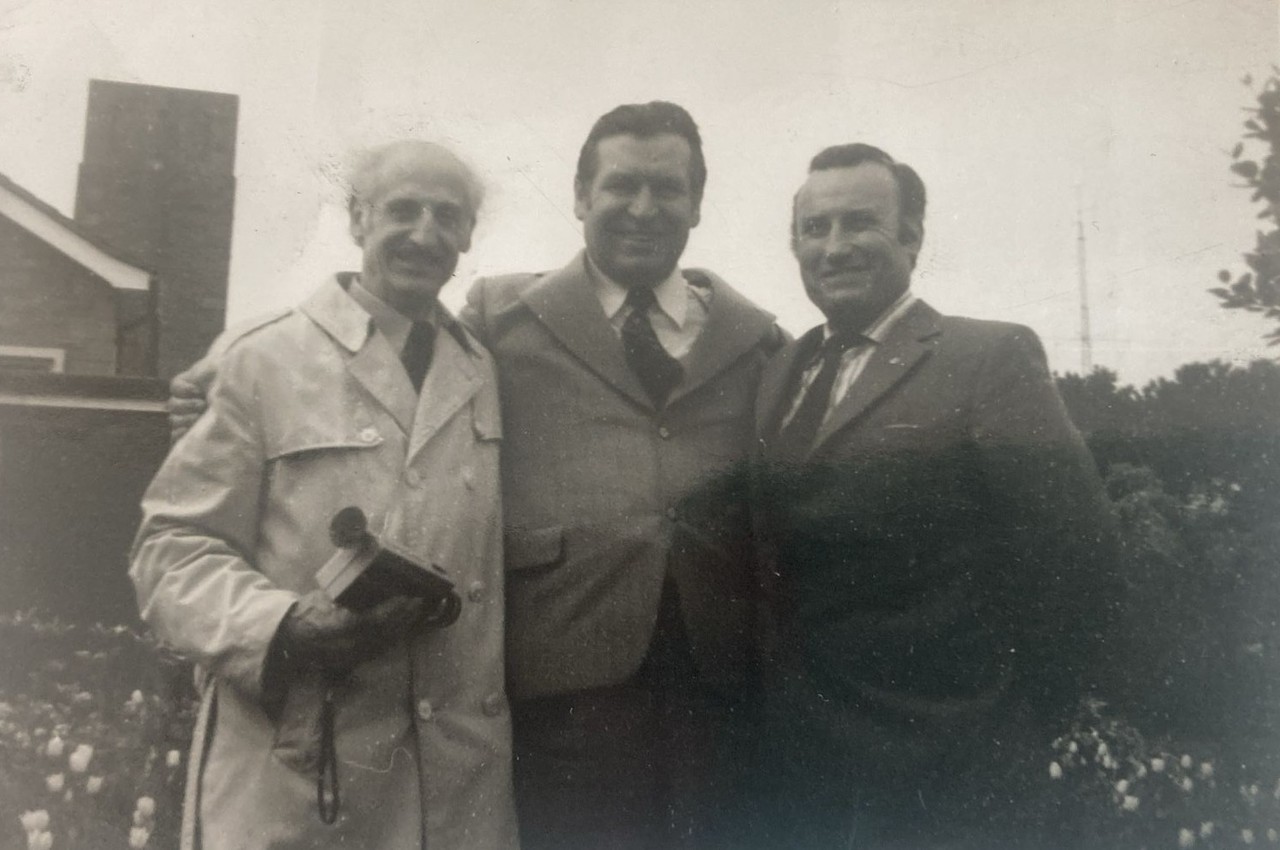
Vasilly prevailed in his personal fight for survival and revisited Jersey in 1972. It was then that he was reunited with Spaniards Vincente Gasulla-Sole, an orderly at the OT Hospital who saved his life, and Francisco Font-Saboya, whom he had met at Lager Brinkforth. The two men reminisced about their fight over a half-rotten potato.