#Story
The Fate of Sergi Gerardo
Sergi Gerardo, a soldier who fought during the war in the Greek Campaign, joined the armed resistance in September 1943. Five months later he was caught by the Nazis and imprisoned. On 24 March 1944, he was killed at the Fosse Ardeatine.
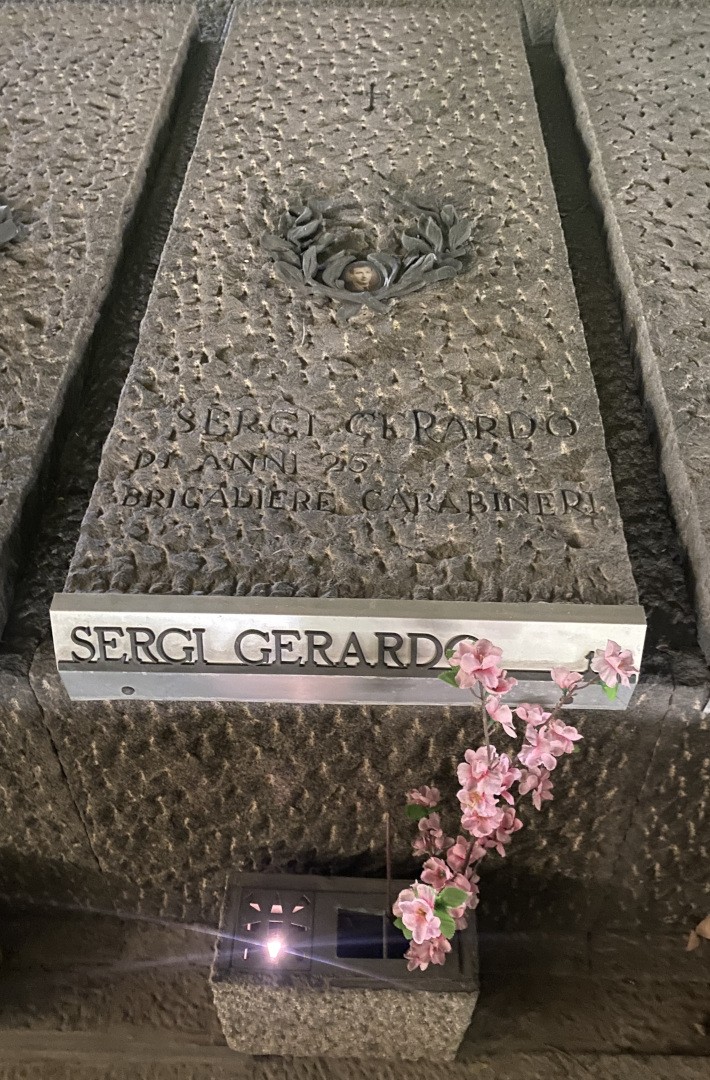
Sergi Gerardo was born in Portoscuso on 25 March 1917. In early 1938, he was drafted and attended the 'Carabinieri Foot Cadets' course at the Legion of Cadets in Rome. After completing his military service in Gela, he enrolled at the 'De Cosmi' teacher training institute in Palermo.
On 8 December 1940, Gerardo was assigned to the mobilized VIII Carabinieri Battalion, which was soon deployed to Albania to fight in the Greek campaign. In the summer of 1941, the battalion was stationed in Volos, Thessaly. Sergi was then promoted to Brigadier and given command of the station in Kala Nera, a village by the sea near Volos. At the end of August 1943, just before Italy's surrender to the Allies and the German occupation of northern Italy, the battalion was called back to Italy.
Upon their return, the Germans disarmed the battalion and imprisoned them in a camp. Gerardo escaped and fled to Rome, where he joined the local underground Carabinieri organization, which had the nickname Bande Caruso because it was under the leadership of Filippe Caruso. He fought on the front lines of the resistance and instilled his love of his country as well as courage in his fellow fighters. Betrayed by a spy, he was arrested on 14 February 1944, and imprisoned by the SS in the Via Tasso prison, where he endured brutal torture. As a reprisal for the Via Rasella attack, where the partisans assassinated 33 Nazis, he was selected as one of the 335 civilians to be executed at the Ardeatine Caves. He was killed on 24 March 1944, just a day before his 27th birthday.
He was posthumously awarded the Gold Medal for Military Valor in 1951. The citation for the medal is displayed at the museum of the Via Tasso Prison, and his grave can be visited at the Ardeatine Caves.