#Story
Young John Atkins and the Dunkirk Evacuation
John Atkins was born in Gravesend (Kent) and he was only 15 years old when he embarked on the Lady Rosebery on 31 May 1940 in Dover, bound for Dunkirk. He was part of the voyage that brought him to Dover, where given his age, he should have been disembarked. Nevertheless, he managed to stay on board.
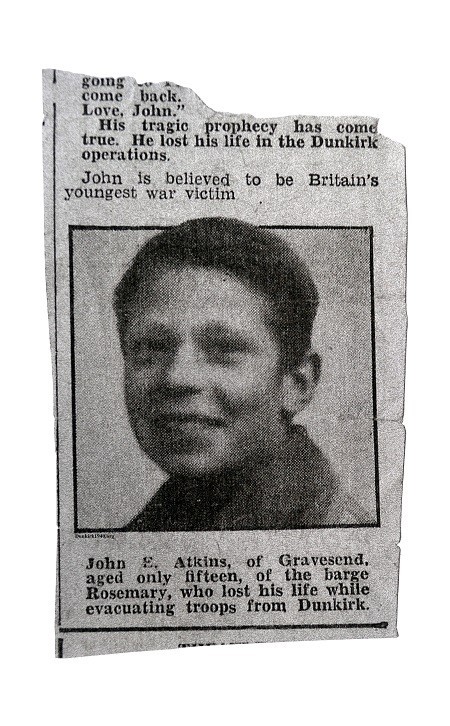
John was onboard one of the many small ships that came to the aid of the British Expeditionary Force (BEF), which were surrounded in the Dunkirk pocket. Working alongside the Royal Navy, many small boats would assist in eventually evacuating over 300,000 soliders off the beaches.
John had been hired a few months earlier on the Lady Rosebery as a cook and third mate. In a letter published in newspapers after his death , he wrote to his family:
"Dear Mother, we have been put under the Navy, now we are going to France today, I may never come back. Don't worry, John."
In a letter to his parents, Lieutenant Colonel Warner, who was in charge of the Saint-Fagan that night, recounted:
"I would probably have sent him ashore if we had been inside Dover Harbour, although he was a very brave young man. For his safety, I asked to take your son on board the tug. We arrived at our position off Malo-les-Bains at about 03:40. At the time of the explosion of the Saint-Fagan, I am unable to say where your son was. (...) Of the twenty six sailors on board, only eight were saved and we lost eighteen."
John Atkins's body was never found, and he is commemorated on the Tower Hill Memorial, London. He is remembered as a member of the Merchant Navy, as Ordinary Seaman John Edward Atkins, aged 15. His date of death is given as 1 June 1940. John’s name is listed on panel 63 and is one of the 36,050 names of Merchant Navy personnel who were killed in the First and Second World War and have no known grave.