#Story
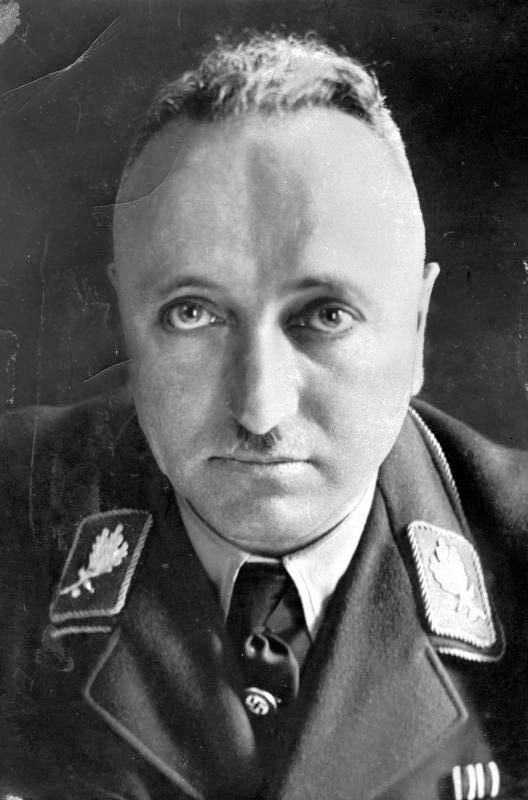
Robert Ley, the architect of Vogelsang
Hitler's decision, to build new schools for NSDAP members, led to the creation of Ordensburg Vogelsang in the forests and hills of the northern Eifel region, near the Belgian border. Vogelsang was designed to educate a new party elite fully loyal to the Führer, the Third Reich, and the racial theories of National Socialism.
Only young men of the “Aryan race,” unbound by any religious affiliation, were permitted to participate, with a clean record being optional, a reflection of the regime's valuation of violence. Their training combined physical activities, such as fencing and horseback riding, with ideological indoctrination. Ambitious expansion plans, including an international airport, a vast stadium, and a hotel for 2,000 girls (while boys were expected to secure future wives), were ultimately abandoned with the onset of the Second World War.
Nazi bureaucrat Robert Ley, the architect of these grand plans, began his radicalisation in 1923 when France and Belgium occupied the Ruhr following Germany’s failure to pay war reparations. The 33-year-old IG Farben worker was incensed by the mistreatment of Germans and soon joined the NSDAP.
His unwavering loyalty to Hitler and virulent antisemitism propelled him into leadership roles within the party. By 1928, Ley had lost his position as a chemist due to his extremist views and alcoholism. In April 1933, he was appointed to lead the German Labour Front (Deutsche Arbeitsfront – DAF), which replaced the defunct trade unions. However, his incompetence allowed his deputy, Reinhard Muchow, a committed Nazi with socialist leanings who advocated for workers’ rights, to rise, until Hitler’s direct intervention restored Ley’s control.
Under the Führer’s protection, Ley embezzled public funds, and the DAF became notorious for his indulgent lifestyle. Ley's tenure became emblematic of the regime's broader corruption and inefficiency.
During the war, Ley was tasked with addressing the housing crisis caused by Allied bombing but proved incapable of solving it. While figures like Fritz Todt and later Albert Speer successfully managed wartime production, Ley’s inefficiency left countless Germans without shelter. His final act was his suicide in Nuremberg, intended as an act of martyrdom, but instead it led to his historical obscurity.
A final testament to his incompetence was the fate of the young men from Vogelsang: instead of becoming the envisioned party elite, most were conscripted as front-line soldiers, with only a few later assuming administrative roles in the occupied East thanks to Alfred Rosenberg.